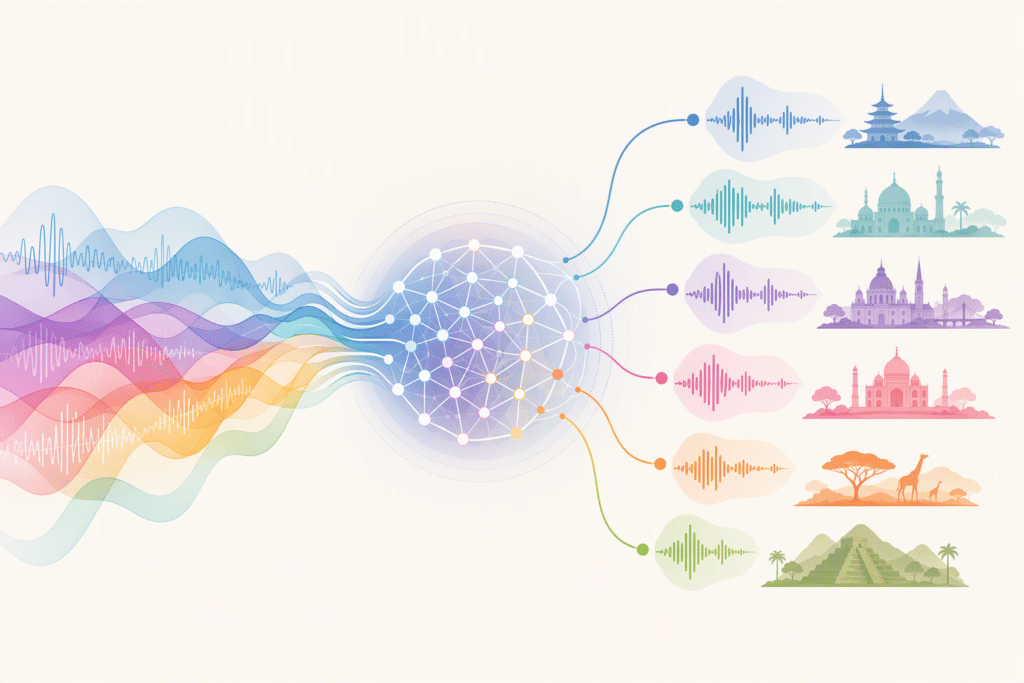

Saaras V4 is Sarvam AI’s latest automatic speech recognition model, designed for multilingual business applications that must handle Indian languages, English accents and imperfect real-world audio. It combines broad language coverage with configurable output formats, language identification and production-oriented deployment options.[1]
What makes Saaras V4 different
The system pairs an audio encoder with an in-house, 3-billion-parameter hybrid state-space language model trained from scratch. The encoder captures phonetic and acoustic information, while a temporal-downsampling adapter shortens the audio sequence and maps it into the decoder’s embedding space. An autoregressive decoder then generates the transcript token by token.[1]
This architecture is intended to address conditions common in business audio, including code-mixing, dialectal variation, compression, clipping, background interference and noisy field recordings.[1] Those capabilities matter for organizations processing contact-center conversations, meetings, interviews or voice interactions outside controlled studio environments.
Five transcript modes from one model
Different workflows need different representations of speech. Saaras V4 provides five output modes without relying on separate transformation pipelines:[1]
- Verbatim: Records every spoken word in the native script.
- Transcribe: Produces native-script text with normalized numbers and dates.
- Codemix: Preserves native English words in English while retaining the surrounding native script.
- Translit: Represents the complete utterance in English script.
- Translate: Produces an English translation with normalized numbers.
Generating these formats within one model can simplify application architecture by avoiding additional preprocessing stages that may introduce cascading errors.[1] A compliance archive could retain verbatim speech, for example, while a customer relationship management workflow consumes normalized text and an analytics process uses English translation.
Benchmark performance across languages
Sarvam AI reports state-of-the-art performance across all 22 Indian languages evaluated. The company also reports the lowest average word error rate across seven English benchmarks spanning Indian-accented English, international accents, meetings, media, financial vocabulary and read speech.[1]
The evaluation uses Word Error Rate, or WER, which counts substitutions, deletions and insertions against a reference transcript. For Indic benchmarks, Sarvam AI also reports LLM-WER, adding semantic adjudication to distinguish meaning-changing errors from orthographic or formatting differences.[1]
Language identification is built into the model, so users do not have to specify the spoken language before transcription. On verified IndicVoices utterances, Sarvam AI reports a language-identification error rate of 5.22% across 22 Indian languages and 2.9% across the ten most widely spoken languages.[1]
Business-ready recognition features
Keyterm prompting can bias recognition toward product names, acronyms, personal names and specialized terminology. On the IndicContextEval L5 keyword-prompting setting, Saaras V4 achieved a reported WER of 16.03% when supplied with a native-script domain-entity list and the language.[1]
For real-time applications, the model supports streaming with a reported time to first token below 150 milliseconds. It also processes multi-minute, long-form audio within a second, according to Sarvam AI.[1] These characteristics support more responsive voice agents and faster downstream processing.
Integration options for production teams
Organizations can access Saaras V4 through three primary interfaces: a synchronous REST API for audio under 30 seconds, a Batch API for files up to two hours and a WebSocket interface that returns partial results for live applications. Batch mode can also enable speaker diarization.[1]
Sarvam AI provides SDKs for Python 3.9 and later and Node.js 18 and later, alongside integrations for Vercel AI SDK, LiveKit Agents and Pipecat Agents.[1] Teams should select an interface based on whether their workflow prioritizes immediate response, long-recording throughput or speaker separation.
A unified path to multilingual voice applications
Saaras V4 brings English and Indic speech recognition into one production model while supporting multiple transcript formats and low-latency streaming. For businesses evaluating multilingual ASR, the next step is to test representative audio, terminology and output modes against operational requirements. Review the Saaras V4 announcement and begin with a focused pilot using real workflow audio.[1]
Sources

Written by
Ganesh Babu Vasantha RajanContent Writer
Ganesh Babu Vasantha Rajan is a contributor at AgilizTech....
View all articles